- - - - - - - - - - - - - - - - - - - - - - - - - - - - - - - - - - -


The Familiar Part II: rescidency GinDS


Presence of an Absence
It is through absence, that meaning emerges. What is not directly seen or remembered can function as a void or a shadow against which everything else takes shape. It is through what is missing that what is present can gain weight and clarity.
I often think of how I remember a face: a smile appears sharply, while the color of the eyes fades. That vagueness, that sense of something missing, is not a failure of memory, but part of the experience itself. Memory does not preserve reality intact; it filters, erodes, and reshapes it.
In The Familiar Part 2, absence is not treated as emptiness, but as an active force. Something withdraws, and in doing so leaves a trace. That trace becomes a place for projection, for hesitation, for imagination. Meaning does not arrive fully formed. It gathers slowly, through what remains unclear, incomplete, or just out of reach.
What is present continues to form itself around what is no longer there.

The Familiar Part 2 continues my ongoing research into how familiarity, memory, and perception take shape through space and time. While Part 1 unfolded as a collective process with children at Gastatelier De Vindplaats, Part 2 shifts the focus toward an introspective and spatial exploration, situated in and around the bunker.
In this second phase, I work with video, sound, and installation to investigate perception as a layered and temporal experience. Fragmented images, repetition, and rhythm create a sensory environment in which moments appear, dissolve, and return. Familiarity is not presented as something stable, but as something that emerges through duration, movement, and attention.
The bunker functions both as a physical site and as a mental space. Its enclosed architecture intensifies the experience of inside and outside, presence and absence. New video recordings made in and around the bunker are combined with existing material from my visual archive, allowing past and present to overlap. Images no longer document a place directly, but register traces: reflections, transitions, echoes of lived moments.
In The Familiar Part 2, memory unfolds as a spatial condition rather than a narrative. Time bends, loops, and layers itself, shaping an environment in which the viewer is invited to dwell rather than observe from a distance. What feels familiar here is not what is fully known, but what slowly reveals itself—through light, sound, and repetition—hovering between recognition and estrangement.

Turning Inward
In the underground bunker of Residency GinDS, The Familiar turns inward. This phase shifts away from a social perspective toward a more introspective exploration of space, memory, and inner time.
The isolation of the bunker allows for a slower and more reflective process. The thick walls, limited light, and enclosed acoustics intensify the awareness of being inside—both physically and mentally. The space becomes a site for a dialogue between inner and outer worlds, where perception is shaped not by constant stimuli, but by duration, repetition, and attention.
Working with light, sound, and layered materials, I explore how memory leaves traces in space and how familiarity can quietly emerge in a place marked by absence. Rather than presenting images as representations, this phase focuses on how moments surface, linger, and dissolve—how something begins to feel known without ever fully revealing itself.




From Individual to Collective Thinking
My practice often begins in solitude: through drawing, photographing, writing, and assembling images as a way of thinking. These individual processes form the ground from which The Familiar emerged.
During my residency at Gastatelier De Vindplaats, this way of working expanded into a collective space. Associative thinking—previously internal—became shared and visible. Images, words, and ideas circulated between children, participants, and myself, continuously shifting through dialogue and collaboration. Meaning was no longer formed privately, but through interaction, disagreement, and overlap.
This movement from individual to collective thinking revealed how familiarity is not something we possess alone, but something that takes shape between people. What began as a personal investigation into memory and perception transformed into a shared process, laying the foundation for The Familiar – Part 1.
In The Familiar – Part 2, this process turns inward again. Working alone in the bunker, I return to solitude—but not to the same starting point. The collective experiences, gestures, and images developed earlier remain present as internalized traces. In isolation, these shared forms are slowed down, reworked, and tested against space, duration, and memory. Solitude here is no longer a point of origin, but a site of reflection, where the collective is carried forward and transformed.

Associative Thinking: Photography, Text, and Collage
A recurring question in my work is how something that is almost disappearing—a shadow, a memory, an echo—can nevertheless remain tangibly present. Photography, text, and collage allow me to approach this question through associative thinking.
In these works, images, words, and fragments coexist without fixed hierarchy. They form mind-like structures in which meaning does not unfold linearly, but through repetition, displacement, and connection. Rather than illustrating ideas, these associative constructions function as thinking spaces—places where relationships between memory, perception, and material can emerge.
This way of working is not preparatory or retrospective. It is an active method within my practice, one that opens new directions and allows unexpected connections to surface. The associative logic developed here later expands into spatial, collective, and architectural forms within The Familiar.


The Bunker as Site
The bunker is not a backdrop for the work, but an active site that shapes perception, time, and the making process itself. Its thick concrete walls, narrow passages, and enclosed chambers slow the body down and alter the experience of duration. Light is scarce and uneven; sound lingers. The architecture continuously intervenes in how space is sensed and remembered.
Rather than working toward a fixed outcome, the bunker functions as a field of parallel processes. Works remain in place for long periods, shift gradually, or are reconfigured over time. Installations, drawings, collages, sound recordings, and spatial constructions develop side by side, influencing one another. The project unfolds through repetition and return, allowing time and duration to become active materials.
In the deeper, darker rooms of the bunker, working without visual orientation becomes part of the process. Drawing by touch, moving through space, and building from memory replace direct observation. Here, making is guided less by sight than by bodily presence, recall, and rhythm. The bunker thus becomes a space where what is seen, remembered, and imagined continually overlap.
Seeing and Not Seeing
Seeing is never direct or complete; it is always entangled with belief, doubt, and interpretation. The same applies to the collages and projections in The Familiar – Part 2. Layers remain visible, yet are never fully revealed at once. Images unfold in fragments, depending on where the gaze comes to rest.
What becomes visible always goes hand in hand with what remains unseen. Each image carries traces of blindness—areas that withdraw from view, resist clarity, or remain unresolved. Yet this hiddenness is not a lack; it forms an essential part of the whole. Much like memory, which never appears as a single, clear picture, but as something assembled, partial, and unstable.
When light passes through layered materials, this tension between visible and invisible becomes tangible. Light both reveals and conceals: illuminating one area while casting another into uncertainty. The image becomes a living surface in which time and memory continuously shift and reconfigure themselves. Light functions here not only as a means of seeing, but as a metaphor for consciousness—the attempt to understand what can never be fully grasped.
Painting as Duration
My paintings do not begin with a fixed image or predetermined outcome. They emerge through duration—through the accumulation of gestures, revisions, and pauses over time. Working on site, I allow images to remain open: edges stay unfinished, forms blur or dissolve, and earlier layers remain visible as traces of previous decisions.
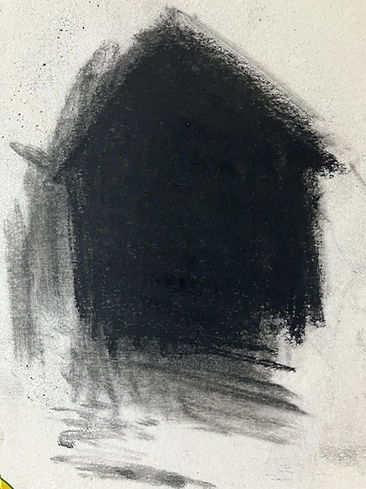
In this process, time becomes embedded in the surface of the painting. Corrections are not erased but absorbed, allowing the image to register its own making. Certain forms return repeatedly—a house, a figure, a landscape—not as planned motifs, but as images that insist on reappearing. Their repetition is shaped by memory rather than intention.
Within The Familiar, painting functions as a slow counterpart to spatial installation and moving image. It offers a condensed temporal space in which duration, presence, and absence can settle into a single surface. The paintings operate as moments of suspension—sites where time lingers, accumulates, and quietly reshapes what is seen.

Mind-maps: Associative Thinking
Associative thinking allows images to remain open. Rather than fixing meaning, it keeps relationships fluid, allowing fragments to resonate across time and context. In this way, thinking becomes spatial: something that unfolds through proximity, layering, and return.
Within The Familiar, this mode of thinking underlies both collective and individual processes. It connects mind-maps, constructions, dioramas, and installations, forming a continuous movement between intuition and reflection, experience and memory.


Repetition and Recontextualization
Images developed during The Familiar – Part 1 at Gastatelier De Vindplaats continue to reappear in my work, particularly in the dioramas. These are not fixed images carried over unchanged, but forms that return, shift, and adapt as they move into new contexts.
Through repetition, images lose their original stability. When reused, they are no longer tied to the moment or place in which they first emerged. Instead, they become flexible structures—open to transformation through scale, material, light, and spatial conditions. What once functioned within a collective setting is reworked within an introspective and architectural environment, where meaning is reshaped by duration and isolation.
In this process, repetition is not about reproduction, but about testing: what remains recognizable, what dissolves, and what new associations surface when an image is placed elsewhere. Each reappearance carries traces of its previous context while absorbing the conditions of the present one. The dioramas function as transitional spaces in which images circulate, mutate, and accumulate memory.
Repetition thus becomes a way of thinking through time. By returning to the same images across different phases of The Familiar, familiarity is not affirmed but questioned—revealing how meaning is never fixed, but continuously negotiated through context, material, and perception.


Dioramas as Mental Spaces
The dioramas occupy an in-between position within The Familiar. Neither purely sculptural nor illustrative, they function as compact mental spaces—fragmented interiors shaped by memory and perception.
Built from found materials, transparent layers, and residual forms, the dioramas do not depict complete places. Instead, they outline the contours of remembered spaces: partial, unstable, and open to projection. Scale shifts and collage techniques create tension between recognition and estrangement, allowing familiar forms to appear altered or displaced.
As such, the dioramas act as transitional structures. They connect drawing, collage, and spatial installation, and form a conceptual bridge between the collective processes of Part 1 and the concentrated, architectural explorations of Part 2.


Video as Temporal Architecture
In my video and sound installations, time functions as a spatial material. Rather than presenting linear narratives, these works create environments shaped by rhythm, repetition, and duration.
Fragments of moving image and sound are arranged into continuously shifting constellations that draw the viewer into the act of perceiving itself. Meaning emerges gradually, through lingering and return, rather than through immediate recognition. Each work proposes a different way of inhabiting time—one that unfolds bodily and attentively.
This approach forms the basis for the video work in The Familiar – Part 2, where newly recorded material from in and around the bunker is integrated into spatial installations. Here, moving image becomes architectural: not a window onto elsewhere, but a temporal structure that shapes how space is sensed and remembered.


Monument Valley: Remnants and Erosion
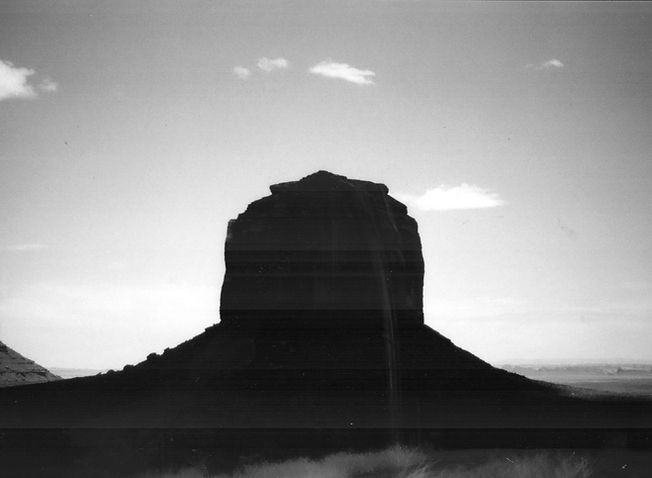
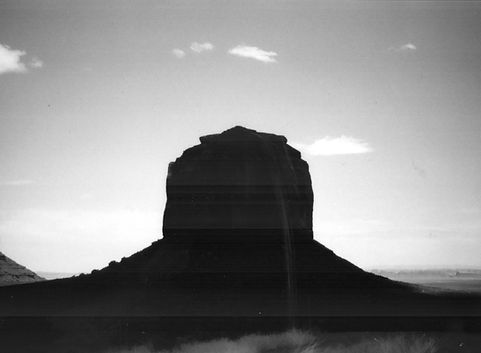
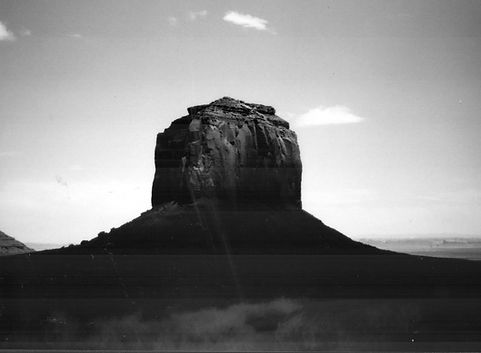
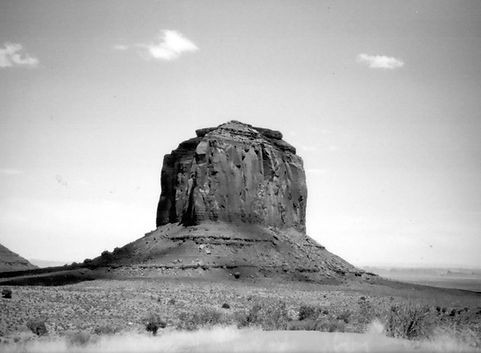
During my journey through Monument Valley, I photographed rock formations shaped by millions of years of erosion—remnants of what was once a flat plateau, now isolated masses rising from the landscape. In the black-and-white images, these forms appear almost entirely black: monumental, closed, and inscrutable, like voids within the image.
What was once continuous has broken apart into fragments. Islands of stone remain, while the larger whole has disappeared from view. The darkness in the photographs was caused by a passing cloud—a brief event that nonetheless evokes a sense of lasting obscurity. Time here is compressed: geological duration intersects with a fleeting moment.
The stones appear not as reconstructions of the past, but as residues—what has been left behind. Memory works in a similar way: not as a faithful account of what happened, but as what remains after time, repetition, and forgetting have taken their course. What water, wind, and time did not erase becomes visible both as form and as absence.
This approach continues in the GinDS bunker. The walls, like eroded rock or layered transparencies, reveal traces of presence and withdrawal. Light moves through the space as it moves through the collages—illuminating some layers while leaving others in shadow. What endures is not a complete image, but a remainder: a structure shaped by erosion, time, and attention.

Shadow of a late arrival
I say I, and somehow I’m already someone else.
Maybe because I’ve changed — a little or a lot, I’m not sure.
Or maybe someone else has quietly taken my place while I wasn’t looking.
He stands where I stood, says the same words, and they sound just as real coming from his mouth.
I say this, but it’s already that.
Some other thing, not identity, but different..
I say here, and it is elsewhere
I’m no longer certain where that is.
I say now, and it is already later
I repeat day. but it feels as night
I try tree, and a house appears instead
The same words I use to hold the world in place,
simple words, familiar ones,
are also the ones that quietly undo it.
Just a faint suggestion that something down there moved.
