- - - - - - - - - - - - - - - - - - - - - - - - - - - - - - - - - - -


The Familiar part I: rescidency Gastatelier de Vindplaats

A recurring question in my work is how something on the verge of disappearance, such as a shadow, memory, or echo, can still remain tangibly present.
The Familiar – Part 1 unfolds from this question as a collective and evolving process.


The Familiar builds on my earlier research into memory and transformation and centers on a key theme in my work: the sense of home. In this project, I examine how what feels familiar can shift or dissolve when context, space, matter, perception, or the body changes. I am interested in how physical and remembered experiences overlap, shaping what we perceive as close, distant, or our own.
What makes a place home? How does memory influence what we experience as safe or recognizable? Often, this feeling is not fixed but a projection toward what was, or what is yet to come.
The project unfolds across two residencies: a social phase at Gastatelier De Vindplaats in Amsterdam, and a solitary phase in the abandoned bunker of Residency GinDS in Hoofddorp.

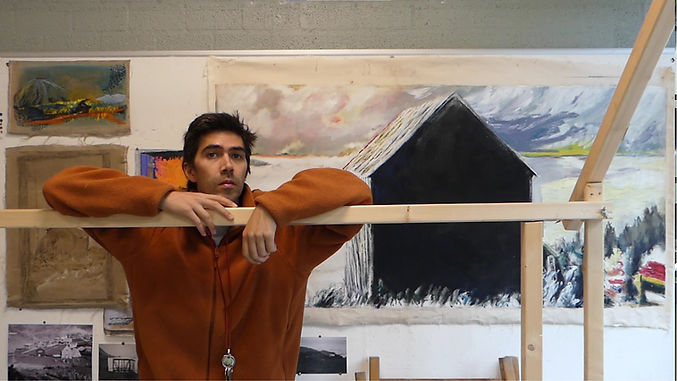

During my three-and-a-half-month residency at Gastatelier De Vindplaats, I worked with children aged six to twelve to explore how memories, imagination, and shared experience shape our sense of home. Through conversations, drawings, mind maps, and large-scale construction projects, we investigated what “home” can mean. For some, it is a place or a room; for others, a memory, a language, a feeling, or a group of people.
The process developed gradually. Small conversations, loose drawings pinned to the walls, and questions circulating through the space formed the starting point. Each day, new groups of children continued where others had left off—adding, altering, erasing, and building upon existing traces. What felt familiar proved to be unstable: meanings shifted, fragmented, and reappeared in unexpected forms. Words became images, images evoked stories, and stories turned back into drawings.
Over time, collective works such as The Big House and The Museum emerged alongside growing mind maps and collages. Together, these works transform the space into a living memory—one shaped through play, repetition, and collaboration. Time unfolds not in straight lines, but in loops and echoes, where the familiar and the unfamiliar continuously flow into one another.
In this way, home is not presented as a fixed place, but as something that is constantly rebuilt through time, material, and shared experience.


The Big House: Mirroring and Transformation
Each group works on The Big House on a different day and encounters traces left by the previous one: walls, windows, drawings, ideas, and found objects. They add something, change something, erase something.
The children also take on different roles: architect, artist, decorator, politician, connector. How do the choices of one group influence the next? How does the house shape itself as a collective construction?
What stood out to me in the studio and during the building of The Big House was how constantly the children mirror and transform one another’s gestures. Everything they encounter: another child’s drawing or an object found on the street —becomes part of their process. The Big House functions as a miniature society in which ideas, objects, and memories circulate. What is made today is reworked or transformed tomorrow.
A significant moment occurred when one of the builders, T., moved away. T. had been building The Big House together with A. and A. every Wednesday. A. and A. were deeply saddened by T.’s departure. How do we deal with this? Can we remember him in some way?


Portrait of T, by A. and me


Conversations About Home: Missing and Remembering
In some conversations, home became something material. Children pointed to a bed, a bedroom, a couch. In other moments, it became something immaterial: a feeling or an experience. B. spoke about a memory filled with atmospheric light, beautiful trees, and a large garden in Arizona, and she lit up as she spoke.
Some meanings seem to arise only through absence, I thought. It felt as if the absence of that place made the memory more present. Missing something makes its meaning tangible. I began to understand that estrangement helps clarify what is familiar, and that the experience of familiarity is a continuous dialogue between presence and absence.
Perhaps missing works as a kind of inverted presence. Something or someone disappears from your immediate surroundings, but becomes sharper in your thoughts because of it. It appears in another form—not as a concrete space or tangible object, but as its imprint. That imprint is never complete: it slowly fills in, or gradually erodes. Remembering then becomes not a retrieval, but a slow shifting—some parts grow clearer, others fade, and sometimes a detail that once seemed insignificant suddenly takes over the entire image.


I saw this absence reflected again in the dioramas, where images are often constructed from residual forms, cut-outs, and half-recognizable spaces. Places that feel both present and vanished—like a window where the light is visible, but its source is missing.


Resonance: Inside and Outside
While the children build The Big House, they construct walls, windows, and rooms from cardboard, boxes, paint, canvas, transparent sheets, and leftover materials—adding, altering, and reshaping what others have left behind. Their gestures, rhythms, and playful interactions turn the structure into a space in constant transformation.
Parallel to this process, I work alone or in collaboration on a series of small, house-shaped dioramas. I layer images of fleeting, half-present moments from the neighborhood, fragments of the children’s stories and drawings, and material from my own visual archive onto transparent sheets. Through this layering, new images emerge—spaces that exist between shadow and reality, between memory and matter.
The children’s work and mine resonate within a shared process of repetition and transformation. They adopt and reshape each other’s gestures; I gather echoes of their actions, their stories, and my own past. The miniature houses and the large cardboard house reflect one another as inside and outside, micro and macro. While the children build walls, windows, and doors in physical space, I build the memory of that space—tracing the gestures, objects, and stories that take place there. Together, these parallel constructions investigate how home comes into being not as something owned, but as something shared, unfolding through time, material, and light.


Hovering Between 2D and 3D
I noticed that spatial objects in the room tended to attract the children’s attention more readily than paintings or drawings on the wall. At least, they were more inclined to walk toward them. Children respond to spatial objects and to touch.
In their own projects, they constantly move back and forth between 2D and 3D—between drawing and building.


Dioramas and Collages
The children build upon what is already there:
a box, a leftover piece of cardboard, a found object.
Something similar happens in my collages.
I work with fragments from my archive—recent material as well as images from years ago—which blend with traces from the studio and the neighborhood.
Children’s drawings, small objects, or accidental finds appear in my collages, where they merge with my own memory images. Their images and stories introduce unexpected perspectives that place my archive back into relation with the present.


Ready-Made Art / Nature
Children naturally create ready-made art. Any object they find—a box, a piece of cardboard, a feather—can become part of a construction or a drawing. Nothing is predetermined; everything is usable. Everyday materials are transformed into something valuable and meaningful.
What matters most seems to be the process itself: searching, adding, changing, transforming.


In the collages, transparent layers slide over one another; some images come to the foreground, others recede but remain tangibly present. Seeing is never direct or complete: what becomes visible always exists alongside what remains unseen.
The dioramas do not so much depict a complete place as they trace the outline of a memory.


Collective mind-maps: Visible Conversations
The notice boards in the studio function as open spaces for exchanging thoughts about home. Through writing and drawing, children translate “home” into their own language.
“What does home mean to you?”
F. wrote: “Home means a safe place when there is a storm.”
“What do you miss about home?”
“Nothing, I don’t need anything!!”
…
A. drew a boy and a girl on a football field. At first, I thought this was a humorous response to the question: “What do you think about when you are at home?”
Later, I realized she might actually have a football field right outside her front door.
…
What struck me was that no answer ever stayed fixed. Responses changed from day to day, and the context in which a question was asked mattered. Words and images kept shifting.
I asked C. what he feels when he arrives in a new or unfamiliar place.
“Exciting…,” he says softly.
“And how do you feel about traveling to a new place?”
“Very fun!”


Passing Messages: Asynchronous Collaboration
To connect the different groups working on The Big House from day to day, I introduced tools that allowed the children to pass messages to one another. Sometimes this took the form of a secret box for drawings or small objects; at other times, short audio recordings in which they explained what they had made or what they planned for the next session.
In this way, a conversation developed between children who never met directly, yet still collaborated in building something together. Each group responded to traces left behind—voices, images, intentions—adding their own layer to the process.
The house gradually became more than a cardboard construction. It turned into a shared memory, built from overlapping ideas, voices, and images. Everyone contributed something of themselves: a detail from home, a memory, or a wish. Through this asynchronous collaboration, the house grew into a living collage of what home can mean—shaped collectively, across time.

The Origin of the Forgotten
Both The Big House and the plinths of the dioramas are largely built from what others have left behind: objects found on the street, salvaged from bulky waste, or abandoned during a move. These are objects that have lost their function, been declared “excess,” or were too heavy to carry along.
In the exhibition, each object becomes part of a new construction, a new composition of memory and experience. The plinth itself acts as an instrument: a place where the old sheds light on the new, and where the lost merges with what is yet to be discovered.


Inverted Light
In the collages, I also work partly with photographic negatives: inverted light values, shadows that become light, shapes that emerge as residual forms. This began almost accidentally—with an inverted scan and an error in the printing process.
It reminded me of how memories exist somewhere between presence and absence. You can still see what is in the image, but it is no longer directly accessible.
A negative shows what once was, but not in the way it was experienced. Light that once fell on a place appears as darkness; dark areas light up.
This shift detaches the image from its original time and brings it closer to how memories often function: fragmented, displaced, unreliable, yet full of meaning.
Not because the image is simply reversed, but because it preserves a structure—a contour, a residual form. It shows that what you see always coincides with what you do not see. Every image carries a double layer: the visible and the vanished. And sometimes meaning arises precisely through inversion, through loss, through the emptiness that presents itself as form.


Bos en Lommer
By chance, during an entirely unplanned moment, someone told me that the word “lommer” means “the shadow of foliage.” Around the same time, during my walks through the neighborhood, I had been photographing patches of leaf shadows. These images gradually became a recurring motif in the collages.


Layered Memory
The process of layering images into a collage mirrors the way our brains reconstruct memory. Memories are never identical to the original experience; they exist in layers. Familiar elements resurface while new ones shift on top, subtly transforming—much like the images in these collages.
Together with the children, we build a stack of evolving images: responding, adding, and reshaping them within a shared space of visual exchange. Each emerging image carries traces of others—sometimes distorted, sometimes sharpened by time—unfolding like overlapping transparencies in a play of absence and presence. What becomes visible simultaneously evokes what remains hidden.
In this way, the collage is not a fixed construction, but a momentary configuration: a crossroads where subconscious associations temporarily crystallize, open to observation, questioning, and reinterpretation.


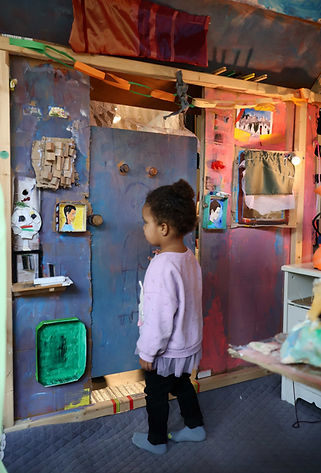

Image Credits:
Photography by Martijntje Baarda (selected images from The Familiar Part I)