- - - - - - - - - - - - - - - - - - - - - - - - - - - - - - - - - - -


Artistic inquiry
My artistic inquiry revolves around the relationship between space, time, memory and perception. I am interested in how places become familiar to us, how they continue to exist within us after they have changed or disappeared, and how what is absent can continue to influence what is present.
I understand a place not as something fixed, but as something continually shaped by time and experience. What we encounter in the present is intertwined with previous experiences, memories and imagination. A room, a house or a landscape can therefore contain different moments at once: what is physically there, what was once there, and what is remembered or imagined.
The recurring image of the house has become important within this research. Rather than using the house simply as a symbol for home or memory, I am interested in it as a structure through which memory can take shape. Rooms, thresholds, windows, darkness, inside and outside provide an architecture in which experiences can be situated, displaced and reconstructed. The house does not simply represent memory; it can become a structure through which memory is continually reorganised.
This has also shifted my attention towards the relationship between space and time. Buildings change, materials deteriorate, memories are reconstructed and places accumulate traces of different moments. What appears fixed might instead be understood as a temporary state within a continuous process of transformation.

Different states of a process
I often work across multiple projects with overlapping themes, moving between drawing, painting, photography, film, sound, text and installation. I use these media as tools to travel from one space to another — be it a place, memory, image or object. Each medium or approach has its own particular way of engaging with what I am investigating and offers a different perspective, both literally and figuratively.
These different approaches can be compared to the way one might approach a lake:
you can observe it from the shore,
view your reflection from above,
experience it by going in,
or intervene by throwing a stone.
Each action reveals a different aspect of the lake
— contemplation, reflection, experience, manipulation
— just as each method uncovers different facets of
the themes I work with.
This idea of different states also extends to the
works themselves. Just as a subject can shift through
different media and approaches, a work does not
necessarily remain fixed in the form or moment in
which it first appeared. I do not understand an
artwork as belonging to a single moment in time.
Works can remain open and return years later: a painting may be painted over or altered, a drawing may reappear within an installation, or an earlier work may enter into a new relationship with something made much later.
Because of this, I increasingly resist presenting my work as a chronological sequence of completed objects. The year in which a work was first made does not necessarily mark its completion, nor does it define its place in time. Different periods can accumulate within the same work, while new contexts can shift how an earlier work is perceived and understood.
My practice develops through this process of returning, layering and reconfiguration. Images, materials, notes and experiences move between works and projects, sometimes disappearing for a period before resurfacing in another form. Rather than replacing what came before, new work can exist alongside it, alter it, or bring something within it back into view.
I think of these works as different states within an ongoing process rather than fixed endpoints. Their meaning and form can remain provisional, allowing connections to emerge across different moments in time.

Practice


Writing
Writing is part of how I think through my work. I use it to record observations, experiences, memories and questions, but also to follow thoughts that do not yet have a clear destination. Writing allows me to stay with something that I have experienced without immediately having to translate it into an image or artwork.
Notes often remain fragmented and can return much later. A sentence written during an experience might eventually connect to a painting, a drawing or something encountered in another place. In this way, writing develops alongside the visual work rather than simply explaining it.
Publications have increasingly become part of this process. They allow images, notes, documentation and reflections to be brought together in another form, creating new relationships between material that may have originated at different moments. A publication can therefore become another space in which the research continues.

Ways of Making
Each medium I work with offers a different way of approaching and translating experience. Painting, drawing, moving image, sound and installation each have their own relationship to perception, space and time, shaping both how an experience takes form and how it can be encountered.
Painting and drawing remain fundamental to my practice because of their immediacy. An image can confront the viewer all at once, before gradually unfolding through looking. I think of painting as a kind of subjective imprint: not a record of what a moment looked like, but a trace of how it was perceived, experienced and transformed through making.
Moving image operates differently. Film unfolds through duration and determines a particular relationship to time, while sound can move beyond its source, travel through architecture and make one space present within another. Installation brings these relationships into physical space, where perception develops through the movement and position of the viewer.
I am curious about how these different forms of perception can exist alongside one another. An experience may become an image, an image may lead to a film, a sound may alter the perception of a painting, or an object may change through the space in which it is encountered. Rather than using different media to describe the same thing, I use their differences to approach something that cannot be experienced from a single position.


Read
Inhabiting
Spending time in a place has become an important part of how I work. Rather than arriving with a fixed idea of what should be made, I allow the work to develop through being there. Over time, a relationship emerges between the place, my experience of it and the work as it unfolds. Architecture, atmosphere, light, sound, encounters and everyday rhythms can all influence the direction the research takes and the forms that emerge from it.
This is why residencies have become particularly important to my practice. They allow observation, making and inhabiting to take place within the same environment over an extended period of time. As this relationship develops, a place can gradually shift from being the location in which work is made to becoming one of the materials through which the work itself develops.
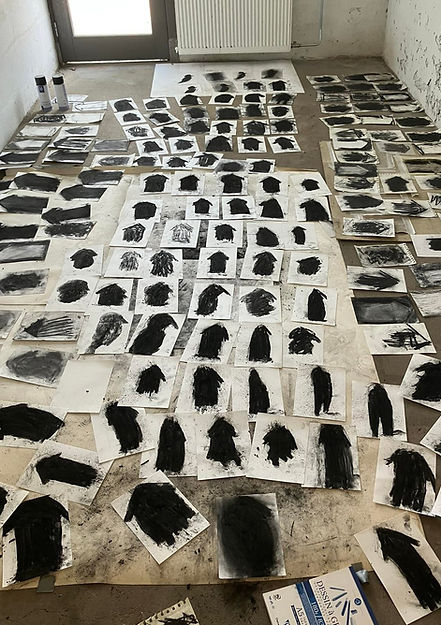
This way of working became increasingly important through The Familiar. At De Vindplaats, working within the everyday environment of the school and together with children showed me how a place can be continuously reconstructed through lived experience, conversation, drawing, playing and building. During The Familiar – Part II, this relationship with place became more physical and immersive. Spending several months inside a former military bunker, its architecture, darkness and atmosphere gradually changed both how I worked and how I perceived the space. Experiences within The Black Shed, for example, travelled into drawings, paintings, writing and installations.
I am curious about what happens when a relationship with a place is sustained long enough for observing, inhabiting and making to become intertwined. A residency, in this sense, becomes more than a period in which to produce work. It creates a situation in which the environment and lived experience can actively shape the artistic process, while the practice itself can change through the experience of being there.

make,
think,
read,
do,
watch
Inhabiting the work
I increasingly approach an exhibition as a temporary constellation in which works, space, light, sound and people come together for a particular period of time. The relationships that emerge between these elements become part of how the work is experienced.
For me, exhibiting is also a way of thinking through the work, but this process can begin long before an exhibition takes shape. When I inhabit a space for a longer period of time, I can gradually bring works into it, move them around, juxtapose them and live with the relationships that emerge. These arrangements do not have to be resolved immediately. By encountering them repeatedly over time, I can observe how the works act upon the space and how the space, in turn, changes the way I see the works.
The space becomes a place in which connections can be tested and allowed to develop. Works made at different moments can temporarily exist beside one another, while images, objects, sound and architecture can enter into relationships that I could not necessarily have anticipated beforehand. In this sense, arranging work in space becomes part of the process of making and thinking.
An exhibition can emerge from this process as one temporary state of the practice. It brings certain relationships into focus for a period of time, without necessarily fixing them. When that constellation dissolves, the works can continue, return to the studio, change, or enter into different relationships elsewhere.


Catalyst


